

Each financial year there's a limit on how much can be contributed to super at the concessional, or before-tax, rate. For most people that limit works on a use-it-or-lose-it basis, but since 2019 there has been an exception. People with a total super balance under $500,000 can carry forward any part of their limit they didn't use, for up to five years. That five-year window means unused amounts from 2021-22 will disappear after 30 June 2027, so this financial year is the last chance to use them.
How the carry-forward rule works
Concessional contributions include the super an employer pays on your behalf, any salary sacrifice, and personal contributions you claim as a tax deduction. They're taxed at 15% inside super, which for most working people is lower than their marginal tax rate. In many years, employer contributions use up only part of the annual limit, and the gap is what can be carried forward.
To use carried-forward amounts, your total super balance must have been below $500,000 on 30 June of the previous financial year, so for this year the test applies at 30 June 2026. The balance is measured for each person separately, which means one partner in a couple may qualify even if the other doesn't. Where unused amounts are available from several years, the oldest are used first.
There's no need to work out the figures by hand. The ATO keeps a record of each person's unused amounts, and the easiest way to see it is through myGov. After signing in to myGov and opening the linked Australian Taxation Office service, select Super, then Information, then Carry-forward concessional contributions.
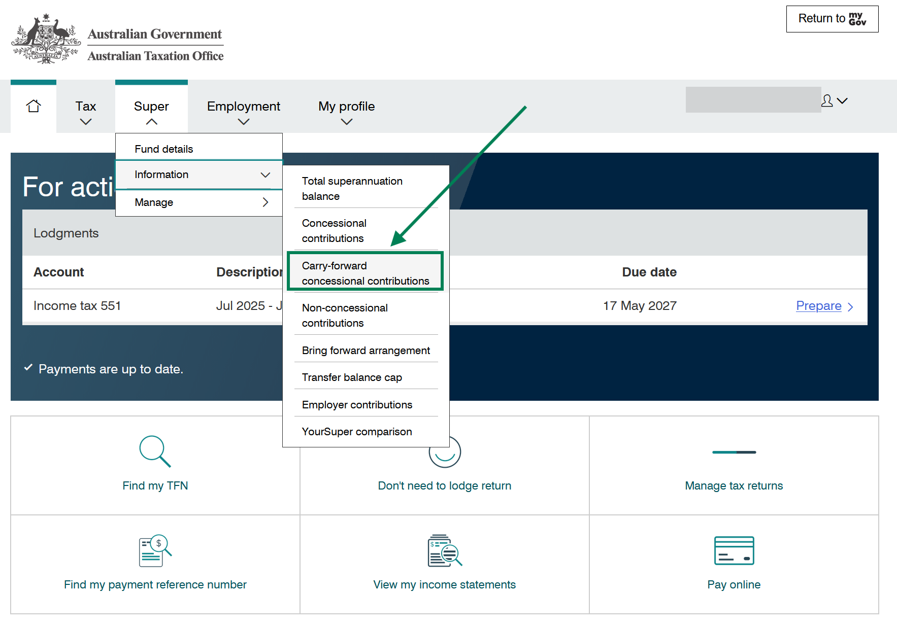
That screen shows the unused amounts available from each of the previous five years, and the ATO service also shows your total super balance as at the previous 30 June. The ATO website's page on the concessional contributions cap explains the rules in more detail, and anyone without a myGov account can call the ATO on 13 10 20.
The ATO's figures depend on super funds reporting contributions, which can take some time, so recent contributions may not yet appear. A contribution also counts towards the financial year in which the fund receives it, rather than the year it was paid, which matters for anything sent close to 30 June.
A worked example
Consider someone who has earned $100,000 a year since 2021-22, has only ever had their employer's compulsory contributions paid into super, and had a total super balance under $500,000 at 30 June 2026. For simplicity, the example assumes their salary stayed the same each year. Each year the Superannuation Guarantee used up part of their limit, and the rest went unused.
| Financial year | Concessional cap | Employer contributions | Unused amount |
|---|---|---|---|
| 2021-22 | $27,500 | $10,000 (10%) | $17,500 |
| 2022-23 | $27,500 | $10,500 (10.5%) | $17,000 |
| 2023-24 | $27,500 | $11,000 (11%) | $16,500 |
| 2024-25 | $30,000 | $11,500 (11.5%) | $18,500 |
| 2025-26 | $30,000 | $12,000 (12%) | $18,000 |
| Total carried forward | $87,500 |
Over five years, $87,500 of unused cap has built up. In 2026-27 the cap is $32,500, and with their employer contributing around $12,000, a further $20,500 of this year's cap is still available. Together, that means they could make personal deductible contributions of up to around $108,000 this financial year without exceeding their limit. If they do nothing, the $17,500 from 2021-22 drops away after 30 June 2027, and each year after that the next oldest amount follows.
Contributing the full amount in an ordinary year would rarely make sense on a $100,000 salary, because the tax benefit shrinks as a large deduction pulls taxable income down into the lower tax brackets. The catch-up is most valuable when it's matched to a year of unusually high income, or spread across the next few years while the unused amounts remain available.
When it tends to be most useful
The rule can suit anyone with spare cash and room under their limit, but it tends to make the most difference in a few situations.
A year of unusually high income, such as one that includes a large bonus or a capital gain from selling shares or an investment property
A partner who has spent time out of the workforce or working part-time, and has built up unused amounts as a result
The final years before retirement, when surplus cash flow is often higher and there's a clearer view of what super will need to provide
A couple looking to even out their super balances over time
A capital gain is the situation most often overlooked. Selling an investment property or a long-held share portfolio can lift taxable income well above normal for a single year, and a deductible super contribution in that same year can reduce the tax payable, provided the timing and paperwork are right.
What to check before contributing
A few practical details decide whether a contribution works as intended. For personal contributions, the tax deduction depends on a notice of intent being lodged with the super fund and acknowledged by the fund before the tax return is lodged, and before any money is withdrawn or rolled out of that fund. Missing this step is one of the most common reasons a deduction is lost. Between ages 67 and 74, claiming a deduction also requires meeting the work test, broadly 40 hours of paid work within 30 consecutive days during the financial year. For higher earners, once income passes $250,000 an additional 15% tax applies to concessional contributions under Division 293, which reduces the benefit.
It's also worth remembering that money contributed to super stays there until a condition of release is met, which for most people means retiring or leaving a job after 60. For someone in their late 50s that's rarely a barrier, but it does mean the contribution should come from money that won't be needed in the meantime.
Because the 2021-22 amounts disappear after 30 June 2027, this is a decision best made well before June rather than in the final week of the financial year, when funds are busy and paperwork deadlines are tight. If you think you may have unused amounts available, please get in touch to discuss whether using them this year makes sense for you.
References
Australian Taxation Office, Concessional contributions cap, accessed 3 November 2026.
Australian Taxation Office, Concessional contributions cap, carry-forward and checking your unused amounts, accessed 3 November 2026.
Australian Taxation Office, Super guarantee rates, key superannuation rates and thresholds, 2021-22 to 2026-27.
Australian Taxation Office, Personal super contributions (notice of intent and work test), accessed 3 November 2026.
Australian Taxation Office, Division 293 tax on concessional contributions by high income earners, accessed 3 November 2026.
Australian Taxation Office, Conditions of super release, accessed 3 November 2026.
Australian Taxation Office, Contact us, accessed 3 November 2026.
SuperGuide, How myGov can help you manage your super, accessed 3 November 2026.